Search This Blog

Monday, 16 October 2023

Air New Zealand domestic timetable 1988


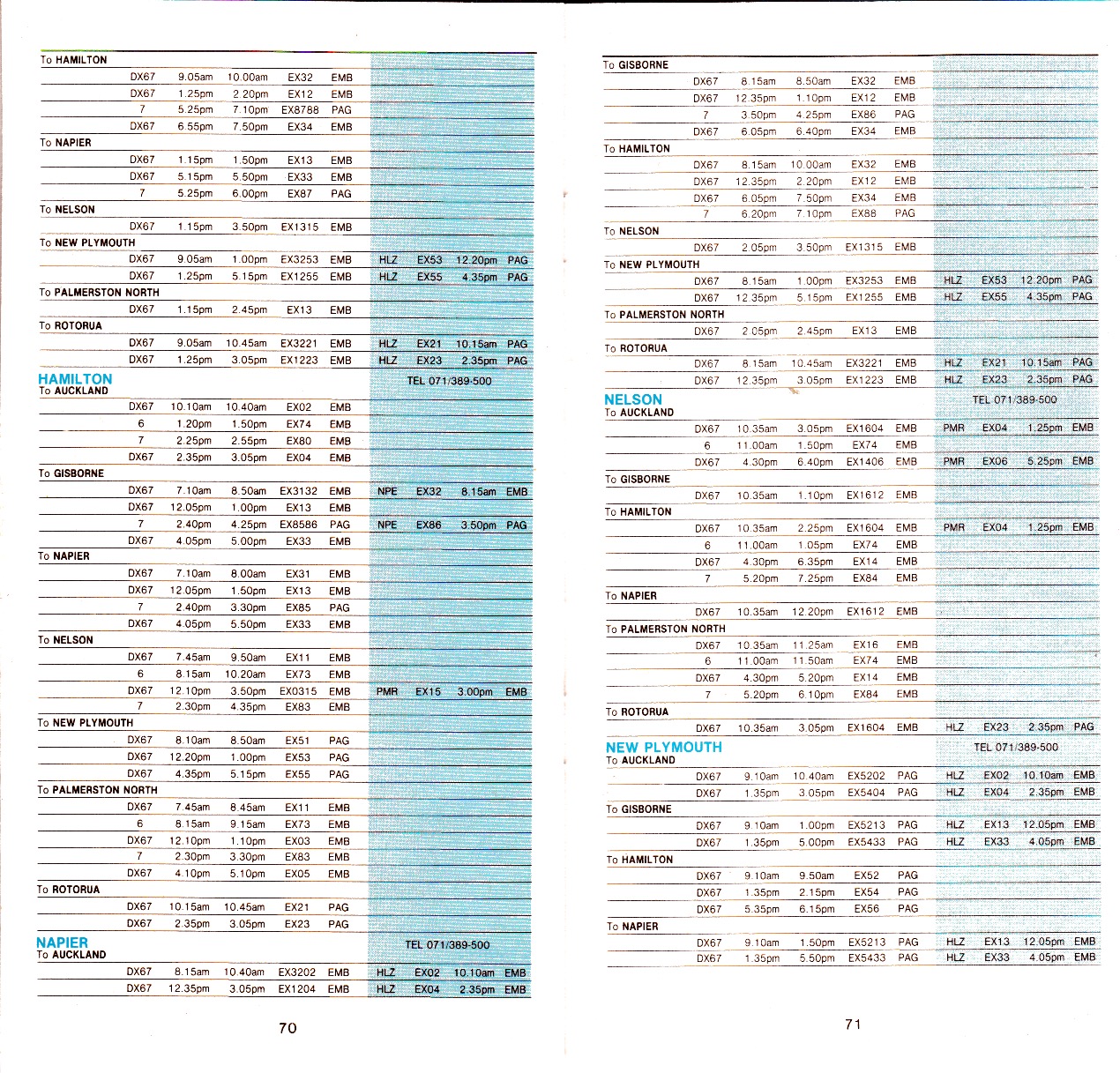
Following nearly a year of direct competition with Ansett New Zealand, Air New Zealand refined its schedule and its domestic product to be more competitive. This is the full timetable for the period from 28 March 1988 until October 1988. 

From a product point of view, Air New Zealand's key innovation was to split its Boeing 737 fleet into two, with different products. Standard two class (with full service economy and Pacific (business) class), and Citysaver (which was an all-economy class no-frills).  Flights were split into City Saver and standard flights, operated by the respective aircraft in the two configurations. Super City Saver were fares off-peak, but there were also off-peak fares with standard aircraft (Thrifty and Super Thrifty fares),

The difference in product was in on-board service, described on pg 77:

  • Pacific Class: Hot meals provided at breakfast, lunch and dinner periods, with snacks at other times (except between Dunedin and Invercargill).  Standard 737 services, and 767 and 747 services.  Depicted in more detail on pg. 97 (with middle seat blocked, sheepskin seat covers and Koru Club access).
  • Economy Class 737, 767 and 747 services: Cold meals at breakfast, lunch and dinner periods, with snack at other times (except between Dunedin and Invercargill). 
  • City Saver/Super City Saver services: Fruit juice only
  • Fokker F27 services between Auckland and Gisborne, Napier, Nelson and Palmerston North. Between Wellington and Hamilton, Rotorua, Tauranga and Timaru. Between Christchurch and Napier and Palmerston North.  Light refreshments, of cheese,  biscuits and beverages.
The two-tier 737 service was ultimately not a success. It was intended to provide a no-frills option for business travellers, with cheaper fares for last-minute travel at peak times, at a lower cost.  The idea being that many travellers cared little about on-board service, but were more price sensitive, so having regular services that were no-frills provided flexibility for travellers.  

However, it did mean there was complexity in levels of service. For casual travellers, they could often get cheaper Thrifty and Super Thrifty fares on full service aircraft, and get refreshments.  The complexity of different levels of service added cost, and Ansett NZ by contrast just had a single full-service operation.  The benefits of a no-frills airline in terms of cost were diluted by the costs of providing the full-service operation as well, without the flexibility of aircraft being able to substitute for each other.  

This timetable also fully integrates Mount Cook Airline services into the timetable. It also has timetables for Safe Air, Bell Air, Eagle Airways and Southern Air, as well as information about air cargo and ground transport transfers from airports served by Air NZ. 

Airfares at the time are also included. For example, Wellington-Auckland varied from $184.80 in Pacific Class ($451 in 2023 prices) one way, to $73 for super thrifty fares ($178 in 2023 prices). 


Air NZ domestic map 1988


Business week timetable


Alexandra and Auckland departures

Auckland departures

Auckland, Bay of Islands and Blenheim departures

Blenheim departures

Blenheim and Christchurch departures

Christchurch departures

Christchurch departures

Dunedin departures

Dunedin and Gisborne departures

Gisborne and Hamilton departures

Hamilton, Hokitika and Invercargill departures

Invercargill departures

Invercargill and Kaitaia departures

Kaitaia, Milford Sound and Mount Cook departures

Mount Cook and Napier departures

Napier and Nelson departures

Nelson and New Plymouth departures

New Plymouth and Oamaru departures

Oamaru, Palmerston North and Queenstown departures

Queenstown and Rotorua departures

Rotorua departures

Rotorua and Taupo departures

Taupo, Tauranga and Te Anau departures

Te Anau and Timaru departures

Timaru, Wanaka and Wanganui departures

Wanganui and Wellington departures

Wellington departures

Wellington departures

Westport, Whakatane and Whangarei departures

Whangarei departures

Safeair, Bell Air and Eagle Airways

Eagle Airways

Eagle Airways and Southern Air

Passenger reservation and baggage information

Baggage and inflight services

Fares and rules

Domestic fare schedule

Domestic fare schedule

Domestic fare schedule

Air cargo


Air cargo

Ground transport Greymouth to Rotorua

Ground transport and offices

Offices and Pacific Class

Wednesday, 11 October 2023

Ansett NZ - Air NZ competition: Air NZ upgrades service.. Ansett struggles financially but shows interest in Trans Tasman services


This 1991 article reports on Air NZ offering new services to compete with Ansett New Zealand, four years after competition emerges. It applies to economy class passengers on major routes at peak times.  The key improvements are:

  • Self-ticketing (paper based because this is well before the internet)
  • Valet parking at Auckland Airport
  • Issuing of both boarding passes for return trips for those without checked baggage
  • Improved domestic meal service supplied by trolley
Ansett New Zealand reported that it would offer all passengers a hot meal service and free wine on evening flights. 


In 1993 it was reported that Ansett New Zealand was losing around $700,000-$1m a week ($1.4m-$2m in 2023 dollars), but there was no indication that the company was pessimistic about its future. The airline was at the time fully owned by TNT and NewsCorp. The airline at this time had transitioned to flying BAe 146 jetliners (known popularly as "whisper jets"). Air NZ reportedly had 60% of the main trunk domestic market (Ansett the remainder).  The article claims that growth in the market will be insufficient to make Ansett NZ profitable, primarily because the market wasn't big enough for two carriers.  The report noted the airline had not indicated it would fly Trans-Tasman noting a key barrier to it was its interest in flying between its own terminals on both sides of the Tasman (none of which have customs/immigration facilities).  Noting the airline had lost over $200m since it had been set up.


Finally it was reported that Ansett NZ wished to fly Trans Tasman in 1994, noting that even if it could not fly between its domestic terminals it would still set up operations. It was said that a key reason Ansett NZ remained operating domestic services was the interest Ansett had generally in operating Trans-Tasman flights and how they could all support and feed into each others' networks.

Tuesday, 3 October 2023

Safe Air - Phasing out of Bristol Freighters in 1985 and closing down in 1990

Safe Air (a subsidiary of NAC  (then Air NZ post merger) from 1972) was once a stalwart operator of both Wellington and Blenheim airports, and I grew up with the drone of Bristol Freighters taking off from Wellington Airport multiple times each day, with their piston engines and bumble bee shape, and less frequently the quiet but larger and visually appealing Armstrong-Whitworth Argosy aircraft with their bulbous nose and twin tails, and as the only four-engined turboprops to fly regularly to and from Wellington, besides occasional visits by RNZAF Hercules (since the demise of the NAC Vickers Viscounts 1in 1975). It is remarkable how important air cargo was for decades across Cook Strait, reflecting a time when shipping was largely not containerised, and the inter island ferries had little competition for freight.  Today most domestic air cargo goes in the belly of scheduled passenger services, with the exception of air cargo Boeing 737s flown by Parcelair between several main centres.

First is an article about the end of the Bristol Freighters in 1985. The Bristol Freighters were unpressurised, and mostly flew freight inter island between Wellington and Blenheim (and before the opening of Wellington Airport in 1959 flew freight from Paraparaumu, under contract for the Railways Department).  The Bristol Freighters also operated until 1982, regular (subsidised contracted to the Department of Internal Affairs) services to the Chatham Islands, carrying passengers as well. This is more fully described in the 3rd Level blog here.  Passengers were also carried in small numbers across Cook Strait if accompanying freight such as cars, but the experience was far from pleasant, with earmuffs supplied in the latter years. For aircraft manufactured 1951-1958, the Bristol Freighters operated for a long time in NZ, and for some years Safe Air was the world's largest operators of Bristol Freighters. 

The second article is about the withdrawal of the Argosy aircraft, which primarily operated freight services between the main centres, including overnight between Auckland and Christchurch. The Argosy were noted for having a purpose-built passenger capsule that was inserted into the pressurised cabin, to carry passengers on the Chatham Islands route.  The Chatham's Island service ended in 1990 following decision by the Government to cease subsidies for the route, the age of the Argosy aircraft and a significant downturn in air cargo demand.  Air NZ chose to cease Safe Air's airline operations that year. The Chathams were subsequently serviced by Mount Cook Airline HS748s on a commercial basis, but also saw the small local airline Air Chathams acquire aircraft of sufficient size to fly to the North and South Islands, which it continues today (Mount Cook Airline discontinued services in 1996 as it was phasing out the HS748 and had decided the replacement ATR72 aircraft could not operate the service economically).


1991 review of Singapore Airlines First Class and Business Class and British Aerospace pitches the BaE ATP to Mount Cook Airline


It is an advertising supplement, but Nigel Coventry does give a written window into flying Singapore Airlines in first class in 1991 from Christchurch to Singapore via Auckland ( by 747). He talks about the entertainment system (quite an innovation at the time), the elaborate lunch and subsequent light meal service.  10 people were flying in the 16 seat cabin, business class and economy both almost full.  His review of business class was that seating was smaller, with less choice of meals.  The Singapore Airlines 747-400s were configured with 24 first class, 70 business class and 316 economy class seats, at a time when business class was like today's premium economy, and first class a very large recliner.  He ends the review noting the 1929 cognac served at S$145 a nip in first class.

Separately the image is the 64 seat BAe ATP aircraft on a sales tour which included New Zealand, as British Aerospace pitches for a replacement to the HS 748 for Mount Cook Airline.  The ATP was not a commercial success for BAe, with only 65 built, due to intense competition with Fokker, Bombardier and ATR (ultimately ATR 72s replaced the HS748s).