Search This Blog

Showing posts with label Trans-Tasman. Show all posts

Thursday, 9 November 2023

Air New Zealand comments on Australia withdrawing from a single Trans Tasman Aviation Market

Although the 'underarm incident' in cricket was once described as the lowest point in Trans-Tasman relations, it was actions by Australian Minister of Transport, Laurie Bremerton, in 1994, that took things close to that point.  

In 1988, the Closer Economic Relations (CER) agreement between Australian and New Zealand added the Trade in Services Protocol, but Australia expressly excluded aviation.  That was in part because Australia's domestic aviation market was still heavily regulated (the "Two Airline Policy"), but New Zealand had already removed capacity restrictions in 1983. 

In 1992, both countries concluded a Memorandum of Understanding (MOU), which lifted capacity restrictions across the Tasman, introduced multiple designation and a double disapproval tariff regime, and set out a phased liberalisation towards full trans-Tasman market access and greater beyond rights by 1994. The MOU also contained a commitment to consult on the subsequent full exchange of beyond rights and cabotage rights.  In effect it would mean Air New Zealand could fly domestically in Australia, which was reciprocity for Ansett New Zealand operating domestically in New Zealand (and of course Qantas could fly domestically in New Zealand as well, if it wished).

Australia withdrew in 1994, through a fax sent to the New Zealand Minister of Transport, Maurice Williamson.  The reason was because the Australian Treasury recommended withdrawal because it would affect the price to be obtained for the pending privatisation of Qantas. Australia would sign a single aviation market agreement in 2001.

After Australia withdrew, Air New Zealand bought this full page ad to comment.


Wednesday, 11 October 2023

Ansett NZ - Air NZ competition: Air NZ upgrades service.. Ansett struggles financially but shows interest in Trans Tasman services


This 1991 article reports on Air NZ offering new services to compete with Ansett New Zealand, four years after competition emerges. It applies to economy class passengers on major routes at peak times.  The key improvements are:

  • Self-ticketing (paper based because this is well before the internet)
  • Valet parking at Auckland Airport
  • Issuing of both boarding passes for return trips for those without checked baggage
  • Improved domestic meal service supplied by trolley
Ansett New Zealand reported that it would offer all passengers a hot meal service and free wine on evening flights. 


In 1993 it was reported that Ansett New Zealand was losing around $700,000-$1m a week ($1.4m-$2m in 2023 dollars), but there was no indication that the company was pessimistic about its future. The airline was at the time fully owned by TNT and NewsCorp. The airline at this time had transitioned to flying BAe 146 jetliners (known popularly as "whisper jets"). Air NZ reportedly had 60% of the main trunk domestic market (Ansett the remainder).  The article claims that growth in the market will be insufficient to make Ansett NZ profitable, primarily because the market wasn't big enough for two carriers.  The report noted the airline had not indicated it would fly Trans-Tasman noting a key barrier to it was its interest in flying between its own terminals on both sides of the Tasman (none of which have customs/immigration facilities).  Noting the airline had lost over $200m since it had been set up.


Finally it was reported that Ansett NZ wished to fly Trans Tasman in 1994, noting that even if it could not fly between its domestic terminals it would still set up operations. It was said that a key reason Ansett NZ remained operating domestic services was the interest Ansett had generally in operating Trans-Tasman flights and how they could all support and feed into each others' networks.

Thursday, 28 September 2023

Trans-Tasman Open Skies? Not yet...


It is a key piece of New Zealand aviation history and indeed Trans-Tasman international relations that Australia and New Zealand were negotiating an agreement to liberalise the airline markets in both countries, effectively creating a single aviation market, and Australia pulled the plug on it in 1994 - because of fears that it would undermine the sale price for Qantas as it was being privatised at the time.

This article from the Evening Post in 18 June 1992 was written by a former transport Minister at the time, Bill Jefferies (who was transport and civil aviation Minister during the second term of the Lange (then Palmer/Moore) Labour Government, at the time of the Bolger Government. 

The article notes the significance of bringing aviation under CER, with the intention of there being a single aviation market, and Australia choosing to undertake its own merger of Qantas with Australian Airlines (formerly TAA), which has parallels with the Air NZ/NAC merger in 1978.  The merged airline was to have 70% of it privatised.  Jefferies writes that this is all good for the public as he summarises the history of airline markets over the years.  He notes New Zealand liberalised before Australia, as Australia at the time still had only one permitted international carrier (Qantas) and two domestic airlines (Australian Airlines and Ansett) with protected status.  Although Ansett had permission to fly domestically in New Zealand, Air New Zealand could not do so in Australia.  

Jefferies expected the single aviation market would see Ansett integrating its New Zealand services into its Australian operations including being able to operate internationally, but also Air New Zealand could fly domestically in Australia, especially between east coast capitals.  He also noted the possibility of being able to market travel to Australia and New Zealand jointly into overseas markets.

In fact, it all fell apart in 1994.  The effects of this were wide ranging. Air New Zealand's only option to be involved domestically in Australia was to buy 50% of Ansett Australia (and later 100% which required Ansett to sell its New Zealand operations), which would prove to be ill-fated for a range of reasons.  An interim agreement in 1996 sought to take some steps towards a single market, which was concluded in 2000. 

 (I was in attendance as an official at the signing of the Memorandum of Understanding in 2000 between Ministers)

Tuesday, 1 August 2023

Air New Zealand Australian Fares Guide 1982


Air New Zealand Australian Fares Guide 1 October 1982

Air New Zealand Australian Fares Guide 1 October 1982

In October 1982 Air New Zealand was only flying direct Trans-Tasman flights from Auckland and Christchurch, and from there to Sydney, Melbourne and Brisbane (plus Perth and Norfolk Island from Auckland).  This is its fares guide and should be understood in the context of bilateral international air rights negotiations and highly regulated fares set by mutual agreement between governments. 

Services were at the time solely operated by Boeing 747s from Auckland and Christchurch (Wellington fares presumably reflected inclusion of domestic connections to those airports), and 737-200s to Norfolk Island.  The 737s had single class service, but the 747 offered economy, business (branded Pacific) and first class.

Assuming a general inflation comparison, every dollar at the time of this fare schedule would be $4.41 today.  So that means quite some airfares:

Auckland-Sydney economy with the cheapest fare was $390 return or $1719 in equivalent value today

Christchurch-Sydney full economy was $716 return or $3158 in today's dollars

Auckland-Melbourne in business class (which at the time was equivalent to premium economy of today plus lounge access) was $954 return or $4207 in today's dollars

Auckland-Perth in first class (after all, it's a longer flight) was $2404 return or $10601 in today's dollars.

The general efficiencies of the airline industry have made a big difference, as has greater competition, which was facilitated by the end of Government-approved airfares in the late 1980s.

Tuesday, 4 July 2023

Air New Zealand Flying Times August 1984 - Special Boeing 767 issue


Flying Times August 1984 - the 767 ER edition

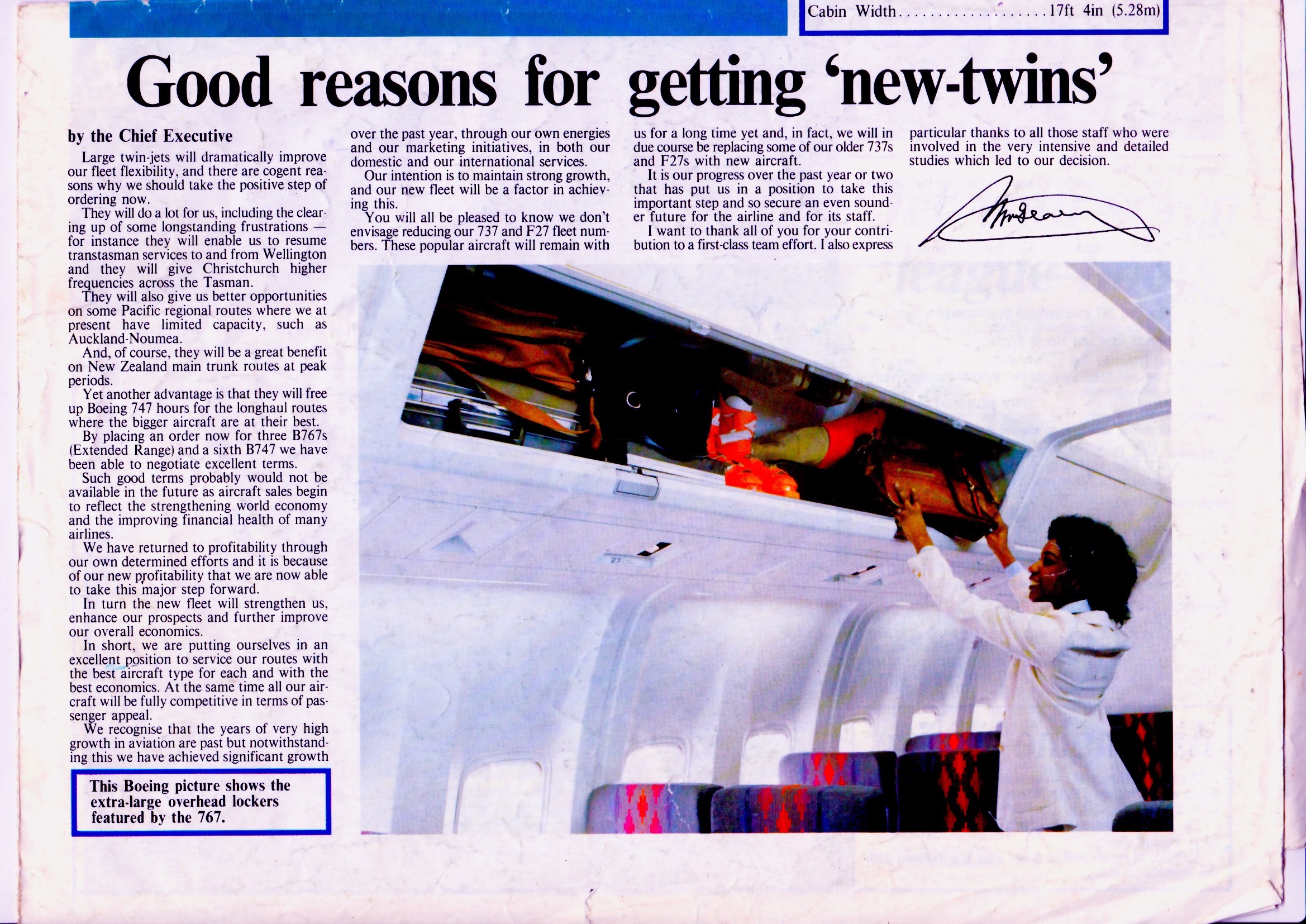
Air NZ CEO describes why the 767s were a good choice

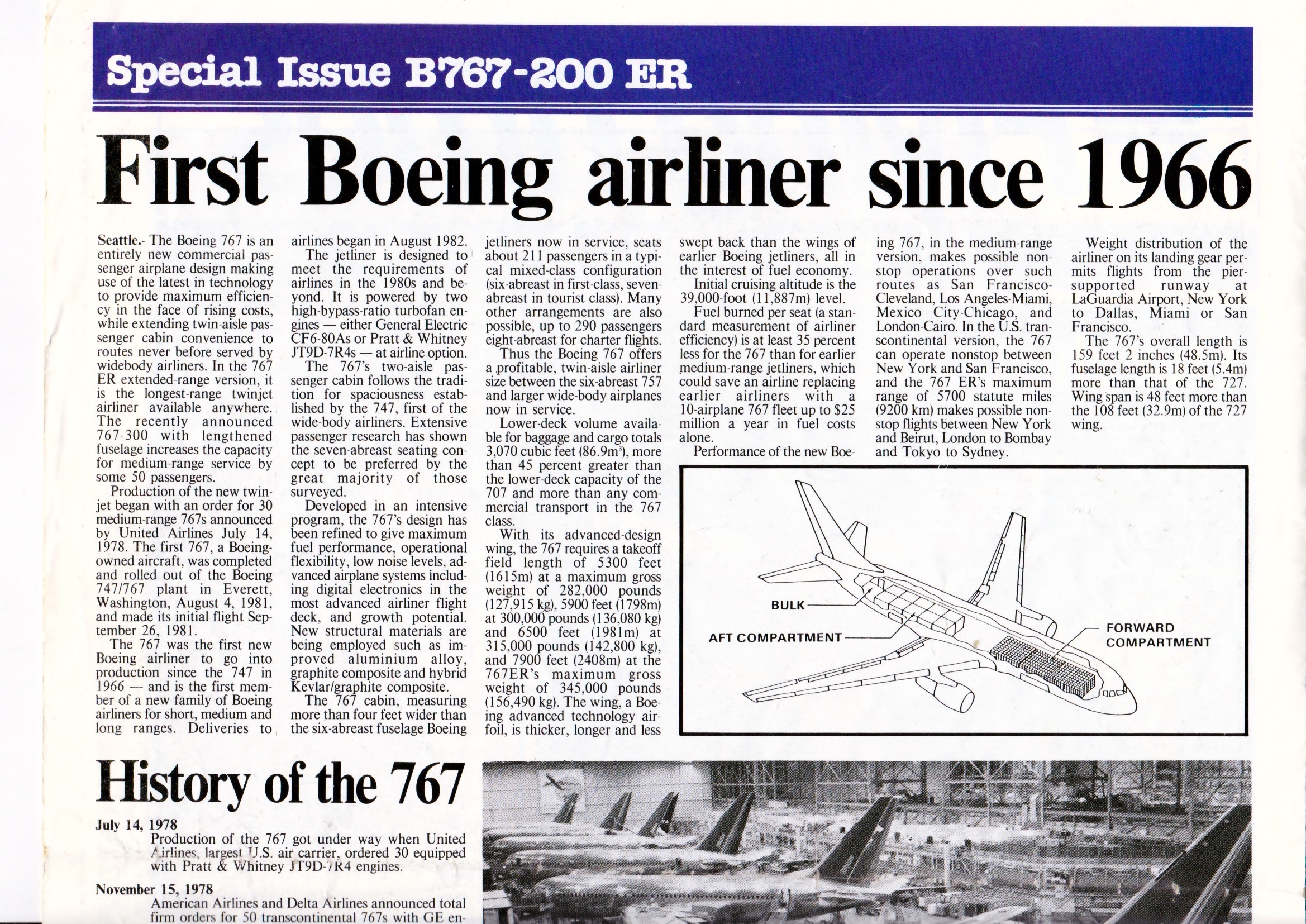
767 first new design since the 747

767 history

Engine choice

Introduction of 767 in service elsewhere


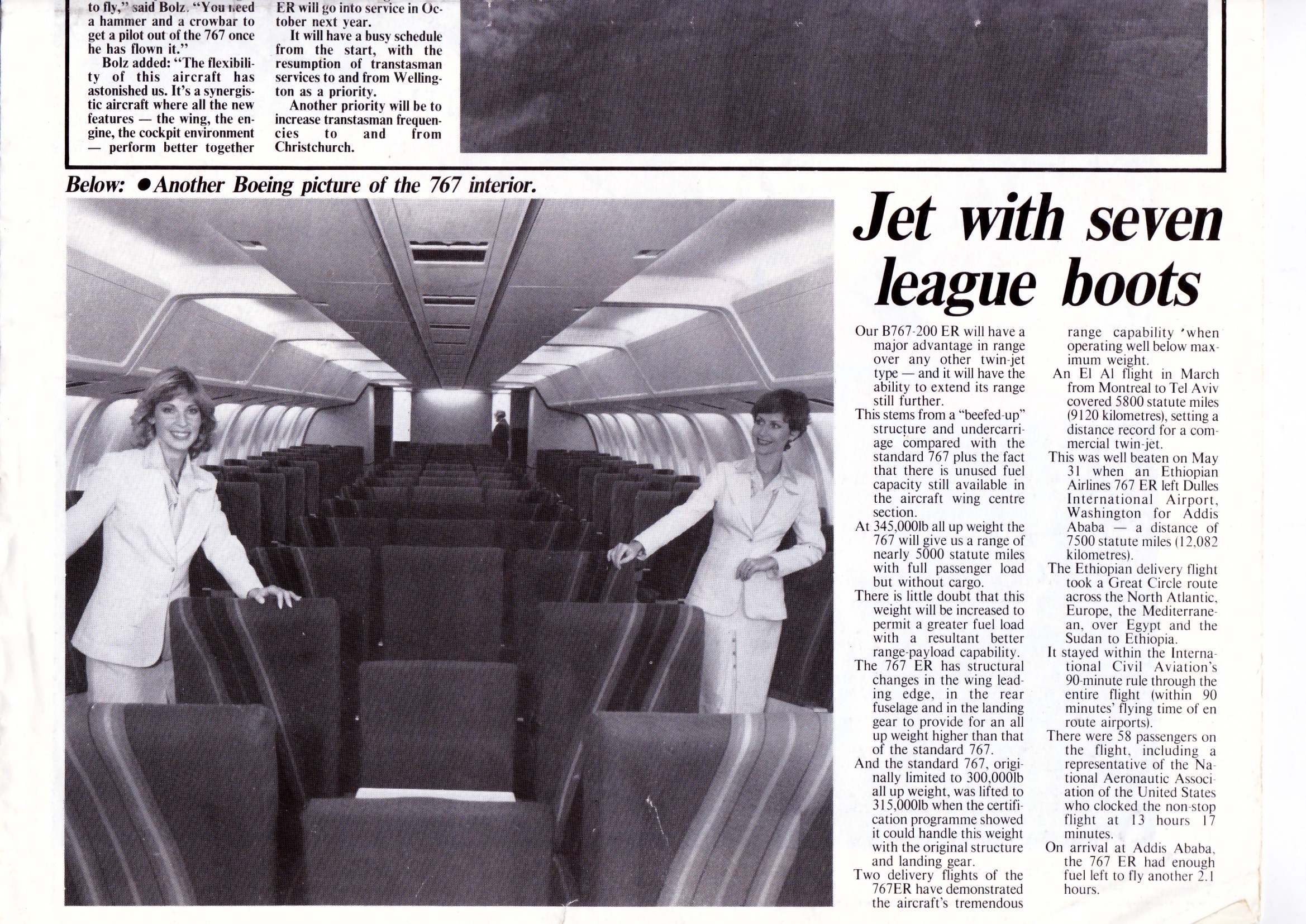
767 range

767 cockpit technology

767 economy class interior (Boeing LOPA)

For the imminent introduction of its first Boeing 767s, Air NZ published this special edition of Flying Times, with a mix of colour and black and white images. It contained no actual images of the first Air NZ 767s, but highlighted why the airline acquired them, and the technical and economic advantages of the airliner type for the airline.  They would fly from September 1985 until 2005, providing the medium-haul backbone for the airline.

Some key points highlighted include:
  • Enabling the resumption of Trans-Tasman services to/from Wellington
  • Enabling higher frequency services Trans-Tasman to/from Christchurch (previously only operated by Boeing 747s)
  • Additional capacity for some Pacific Island routes
  • Able to provide more domestic peak-capacity between Auckland, Wellington and Christchurch
  • Freeing up more Boeing 747 capacity for long-haul routes
A lot of material is republishing of history and data about the Boeing 767 from Boeing, noting production started in 1978 and the first was delivered in 1982. At the time, 18 airlines were operating the 767.  The 2-3-2 LOPA in economy class was noted as desirable to passengers (it certainly was, as most passengers either had a window or aisle seat). It was also notable as being one of the airliners that started having two cathode ray tube displays for information (today it is conventional to have video screens (not CRT any more!) for most instrumentation), alongside the Boeing 757 (which was launched at about the same time).

For Air NZ the Boeing 767-200ER started its expansion in short-medium haul international routes that were not economic to fly Boeing 747s.

Sunday, 14 May 2023

Air New Zealand introduces the Boeing 767-200ER - and reintroduces international flights from Wellington to Australia


Air New Zealand Boeing 767-200ER leaflet 1985

Air New Zealand Boeing 767-200ER leaflet 1985

In 1981 Air NZ ceased flying internationally from Wellington as it withdrew its Douglas DC-8-52 passenger fleet from service due to mounting losses. After that there was around a four year gap before it restarted flights using its first Boeing 767-200ER aircraft. This leaflet promote the new aircraft before they came into operation, as three had been ordered. Not only would they return international flights to Wellington (in competition with Qantas which had not ceased operations as it was using Boeing 747-SP aircraft before switching to its own Boeing 767s before Air NZ started to fly them), but they were the first Air NZ aircraft to operate from Wellington with an international business class and the first Air NZ wide body aircraft for regular service at Wellington (and the last).  The 767-200ER would also become a mainstay of Trans-Tasman flights to and from Christchurch and supplement Auckland services too, including the Perth route, but also would operate regular Auckland-Christchurch and a handful of weekly Auckland-Wellington and Wellington-Christchurch services (my first wide-body aircraft flight was on a 767-200ER from Christchurch to Wellington in my teens).

The Boeing 767-200ER would become a mainstay of Air NZ's short to medium haul international services, operating until 2005, when finally replaced by the airline's first generation of Airbus A320s. Of course the 767s with 220 passengers had a lot of capacity, so service frequencies were very poor by today's standards (by comparison today's Airbus A320NEO have only 165 seats). After a month of introductory service, the full summer schedule indicates only three flights a week WLG-SYD and one a week WLG-MEL and WLG-BNE.  Note also the absence of the early morning departures seen today for this route (no flights before 0800) and midnight arrivals (no arrivals after 2220) for Wellington. 

Air New Zealand Boeing 767 postcard and publicity card

Air New Zealand Boeing 767 publicity card (flip side)